Booster K1 joins the platform — a walking humanoid your agent can drive
The Booster K1 bipedal humanoid now has a first-class driver: walking, gait and mode switching, head aiming, upper-body joint control, preset actions, get-up, trajectory playback, audio and vision — all as tools your agent can call.
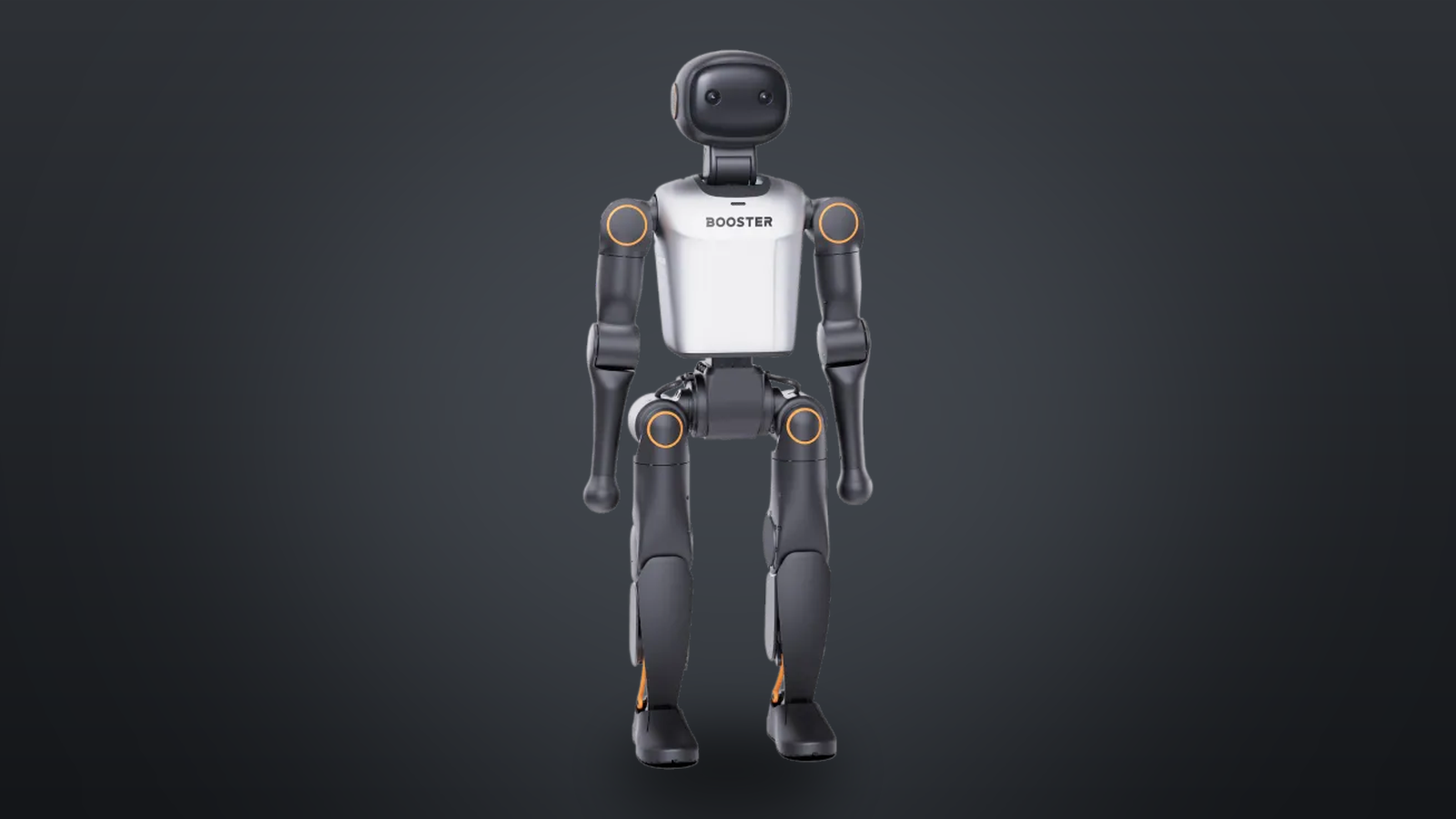
A bipedal humanoid that takes instructions, not joystick input
Walking robots are usually driven by a controller in someone's hands. Plug a Booster K1 into the platform and it becomes something your agent talks to: it can decide to walk over, turn its head towards whoever is speaking, raise an arm, replay a rehearsed motion, and get itself back up after a fall — while you watch every joint, the IMU and the battery on the dashboard.
What you get
- Walking that reads like an intention. The
lococard takes planar velocity (forward, sideways, turn), switches control modes and gaits, aims the head by pitch and yaw, and resets odometry — so "come here and look at me" becomes two ordinary tool calls. - Upper body under direct control.
upper_bodytakes over the head and arms and drives named joints by target position with per-joint stiffness and damping, for gestures and poses you define yourself. - Rehearsed motions, safely awaited.
actionlists the built-in actions, runs one, gets the robot up off the floor, replays a recorded.btrajtrajectory, or cancels what is running. Long moves report their own completion, so the agent stops guessing when a motion has ended. - It can hear and speak.
audioplays local files, sets volume and records;speechadds conversational replies and a voice list. - It can see. A camera card streams to the dashboard, and
detectionruns the on-board vision models. - Everything on-screen. IMU, joint states, battery, odometry and a fall-down flag publish as live topics — plus a robot model, so the 3D view matches the machine in front of you.
The hardware
22 degrees of freedom (six per leg, four per arm, two in the neck), around 95 cm tall and 19.5 kg, with peak joint torque of 60 N·m and dual encoders. Compute comes in three tiers — 48, 117 or 200 TOPS — alongside a stereo depth camera, a 9-axis IMU, a three-mic ring array and a speaker. Battery life is roughly 30 minutes on the 2 Ah pack, or 80 minutes walking at 0.4 m/s on the 5 Ah pack. It is the machine that won KidSize at RoboCup 2025.
Getting started
Deploy the Booster K1 driver from the console; it registers on port 15705 and its cards appear in the sidebar ready to drop onto the canvas. Conversational replies need the vendor's brain extra installed on the robot.
Read the safety notes before your first walk command. Give the robot clear floor space, keep people out of its reach, and stay ready to stop it — every locomotion and action tool moves a machine that can fall.