RM75 can see and grip
A RealSense D435 card publishes colour, depth and infrared from one capture pipeline shared across card instances, found by serial number rather than a renumberable device path. A two-finger gripper card takes 0–1000 over the arm’s existing SDK connection and refuses out-of-range values outright.
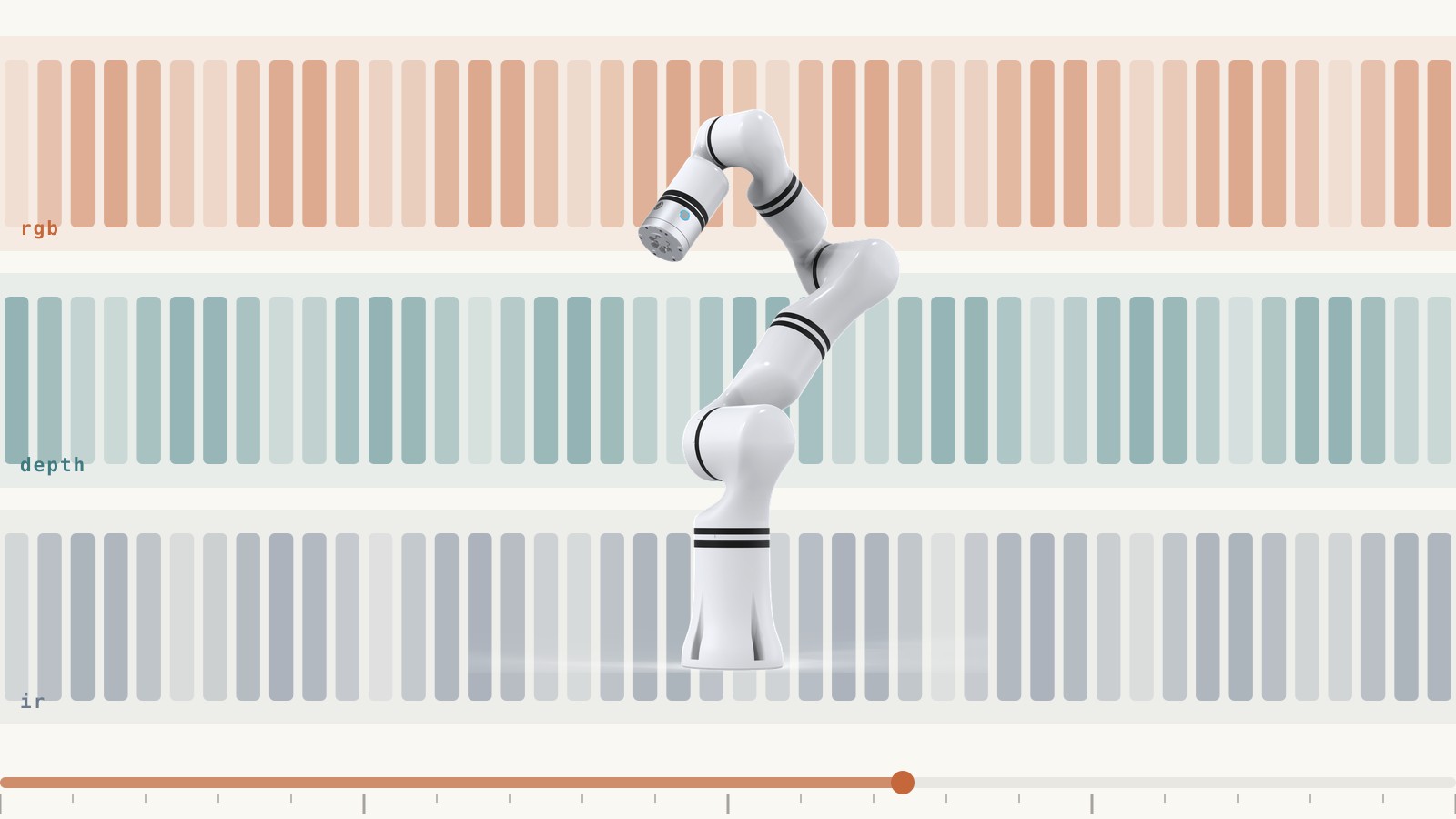
The RealMan RM75-6F-V seven-axis arm gains eyes and a hand: a RealSense camera card and a two-finger gripper card.
Camera
ext_camera drives an Intel RealSense D435 attached to the upper computer, and publishes three streams:
| Output | Format |
|---|---|
| Colour | JPEG |
| Depth | Millimetres, zlib compressed |
| Left infrared | JPEG |
Cameras are found by serial number, not by a device path like /dev/video0 — those get renumbered across replugs, and canvas configuration bound to them eventually talks to the wrong camera.
One physical camera runs one capture pipeline, and its three streams fan out to every card instance. Three cards can therefore watch the same D435 at once without competing for the device.
On USB 3 you get 1280×720 colour with 640×480 depth and infrared at 15 fps; USB 2 falls back to 640×480 at 6 fps.
Gripper
set_position on the gripper card takes 0–1000, mapping to a 0–120 mm stroke. Out-of-range or non-finite values are refused outright rather than moving first and reporting afterwards.
The gripper rides the driver's existing SDK connection, so it takes no extra port on the control box and needs no second container.
Deployment
A missing camera is not a problem: with no device found, ext_camera reports an empty list and the arm and gripper start normally. Deployment stays unprivileged — only the USB bus is exposed, not the whole of /dev.