Visual navigation: no map, no waypoints — name something it can see and it goes there
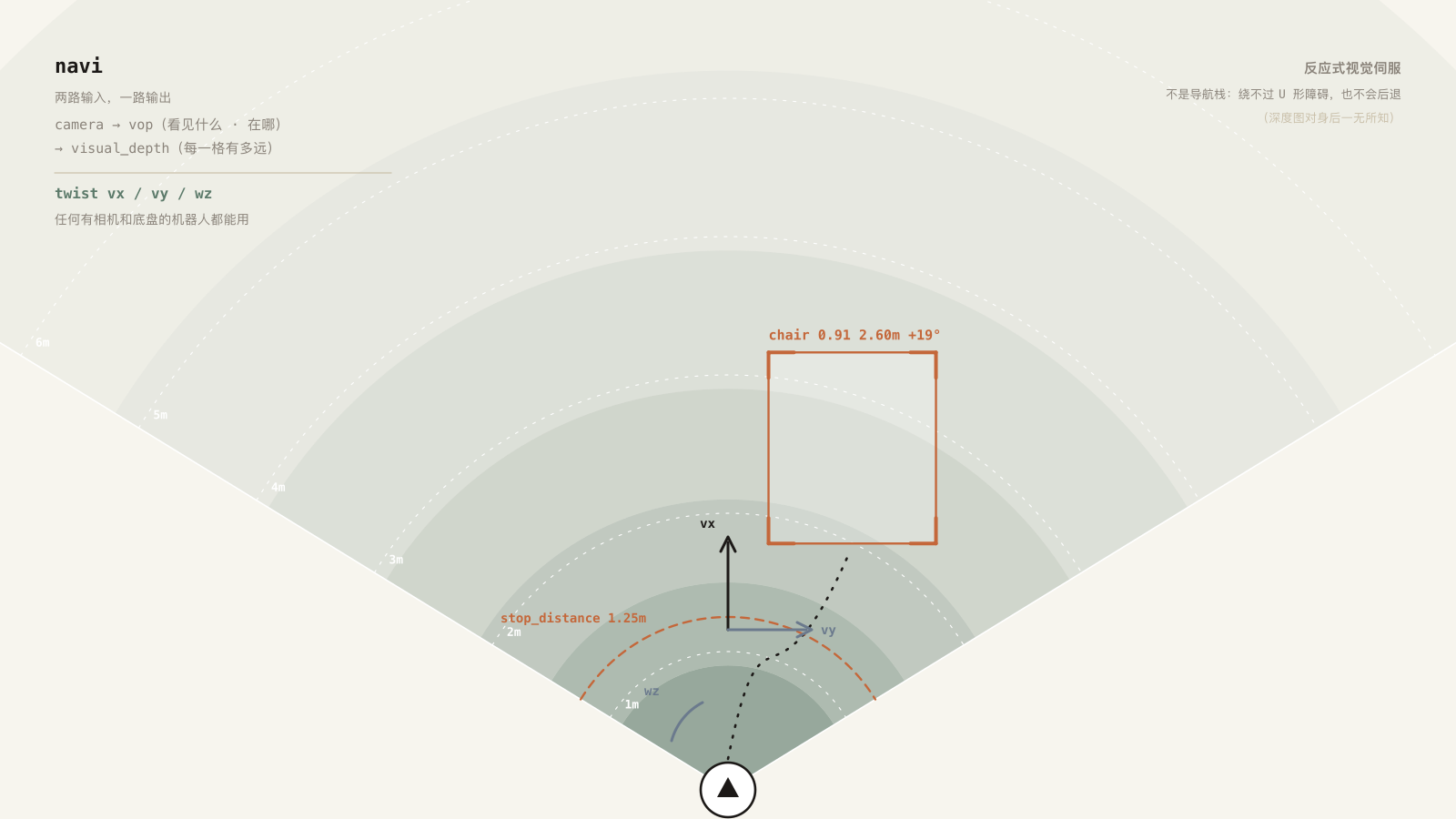
A new navigation card takes what the camera recognises plus a depth image and produces chassis velocity — so any robot with a camera and a chassis can use it, with no vendor mapping stack and no waypoints set up in advance. Name a target and it turns toward it, approaches, slows down and steers around what is close, and stops at the distance you set.
What changes for you
Navigation used to mean: build a map first, mark the waypoints, then ask the robot to go to a waypoint. That is still the right tool for a guided tour of a fixed building. It is the wrong tool for “go to that chair” — the chair is not on anybody’s map, and it moves.
This card closes that gap, and it is generic: its inputs are object detections and a depth image, its output is a body velocity. Nothing in it is specific to one robot or one vendor. If a robot publishes a camera feed and accepts chassis velocity commands, it can navigate this way today.
While approaching, it turns and moves at the same time rather than stop-turn-go, so a chassis that can strafe arrives without the stutter at every correction. A chassis that cannot strafe falls back to the older behaviour by configuration — or automatically, if the driver declares that it has no sideways axis.
Depth you can actually read
The depth view was recoloured. Near is dense, far fades toward the background, and the first two metres take 72% of the colour scale — because that is where the decisions are. The stopping distance is drawn on the robot’s own threshold rather than on a generic ruler, and the navigation overlay can now sit directly on top of the real camera picture. Detections also carry colour now, so the robot can tell you what colour the thing it sees is.
What it is not
This is reactive visual servoing, not a navigation stack. There is no map and no global path: it will not find its way around a U-shaped obstacle, and it does not reverse, because a depth image knows nothing about what is behind the robot. Mapping and planning remain a separate route.