The robot can read your posture — and your gestures
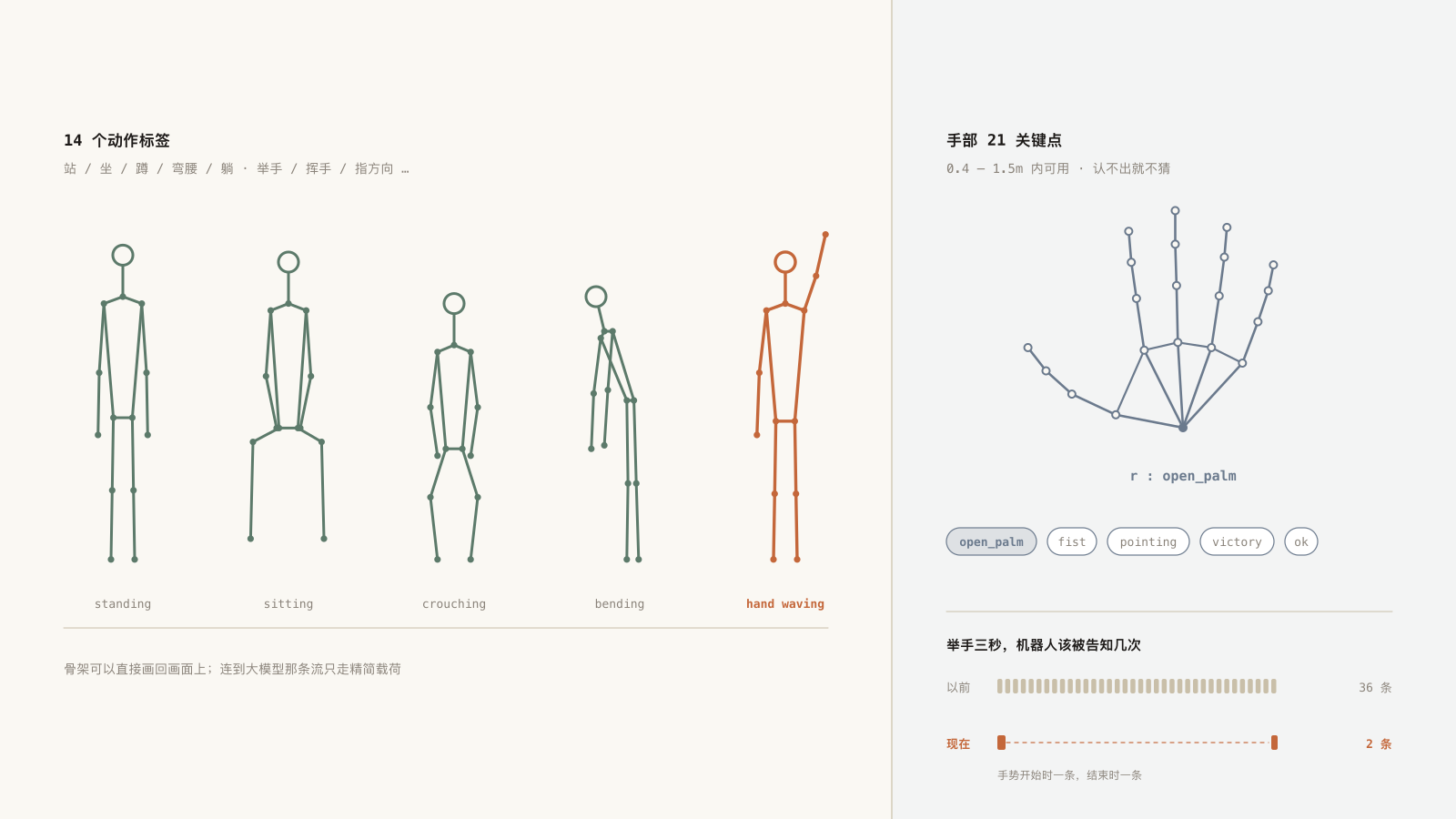
A new card reads human joints from the camera and names what the person is doing — standing, sitting, crouching, bending, lying, raising a hand, waving, pointing: 14 labels in all, with the skeleton drawn on the dashboard and optionally on the picture itself. Waving at it from three metres away now wakes it once, at the moment the gesture starts. Up close it also reads 21 hand keypoints and names the shape: open palm, fist, pointing, victory, OK.
Two ranges, two mechanisms
Far. Raising a hand, waving and pointing are read from the body skeleton, so they work at any distance where the person is visible — no hand model involved.
Near. Within roughly 0.4–1.5 m a 21-keypoint hand channel reads the shape of the hand itself: open palm, fist, pointing (with a direction), victory, OK. When it is not sure it gives no name at all — abstaining is cheaper than guessing wrong.
Gestures arrive as events, not as a status field
Waving for three seconds used to mean telling the model the same thing 36 times, once per frame. Now the gesture is published only when it starts and when it ends — two messages instead of thirty-six, and the one at the start is the one that actually gets the robot’s attention.
Honest about where it works
The hand thresholds were re-calibrated against two batches of real gestures recorded on a robot’s own camera and labelled frame by frame — not against stock photos. On the independent second batch of 86 hands: 61 correct, 0 wrong, 25 abstained. Outside the operating range the failure mode is a confident wrong answer, so the channel is gated on how large the hand actually is in the picture, not on how confident the model says it is.