The robot now knows who is speaking, and in which language
Speaker recognition is in: when the robot hears a sentence, it is told who said it — even when it cannot see a face. If it does not recognise the voice it gives no identity rather than guessing. Speech recognition now also reports the language. And the sentences that were not addressed to the robot are no longer thrown away — they go to a background pass instead.
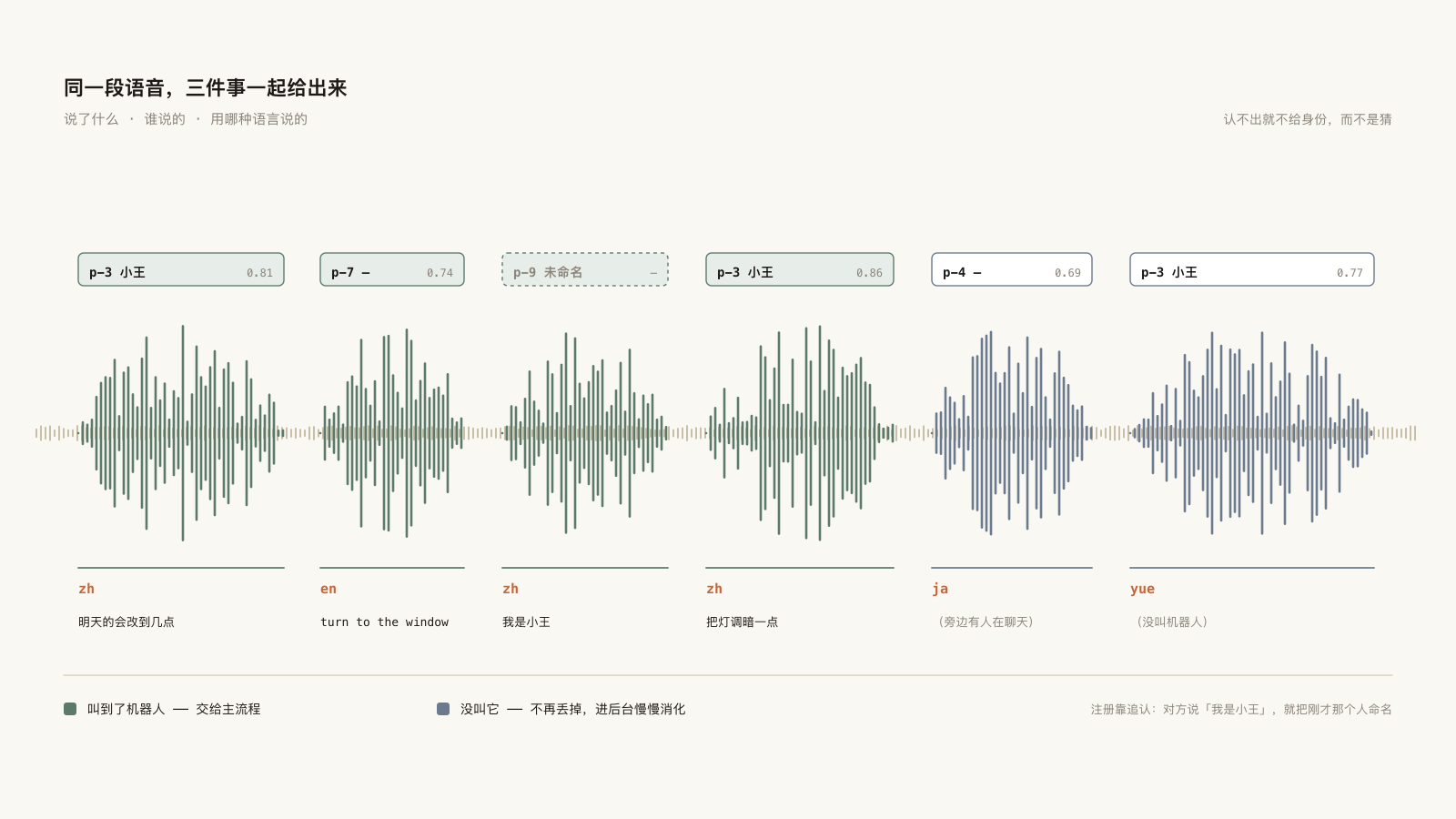
Who said it
The identity is computed on the same slice of audio that speech recognition already cut, so there is no second stream to line up and no alignment error to get wrong. Recognising a voice costs almost nothing in practice: measured on both reference machines, running it alongside speech recognition added 2–7 ms to the end-to-end result rather than the 90–100 ms it takes on its own.
Enrolment is deliberately after the fact. There is no file upload and no URL: a voiceprint bakes in the microphone, the room and the distance, so a phone recording enrolled against a far-field microphone is systematically off in a way no threshold can fix. Instead, the person says “I’m Wang”, and you name whoever just spoke.
In which language
SenseVoice was already computing the language and discarding it. Now it is passed through: Chinese, English, Japanese, Korean and Cantonese all matched on real speech. Emotion is computed too, but it stays off by default — on 351 real utterances 340 came back neutral or unknown, and most of the remaining 11 were simply wrong. A field that is wrong 3% of the time and useless the other 97% is worse than no field.
The sentences nobody addressed to it
Speech that did not call the robot used to be dropped. It now goes to a background pass, so the robot can know what was said around it without that interrupting what it is doing.