The robot stops mistaking its own voice for yours — and you can cut it off mid-sentence
A new echo cancellation card sits between the microphone and everything downstream. The robot’s own speech no longer leaks into its microphone, so it stops treating what it just said as something a person said, and stops filing its own voice away as somebody’s voiceprint. More to the point: you can now interrupt it while it is talking. There is nothing to configure — the card asks the local text-to-speech which channel it is using.
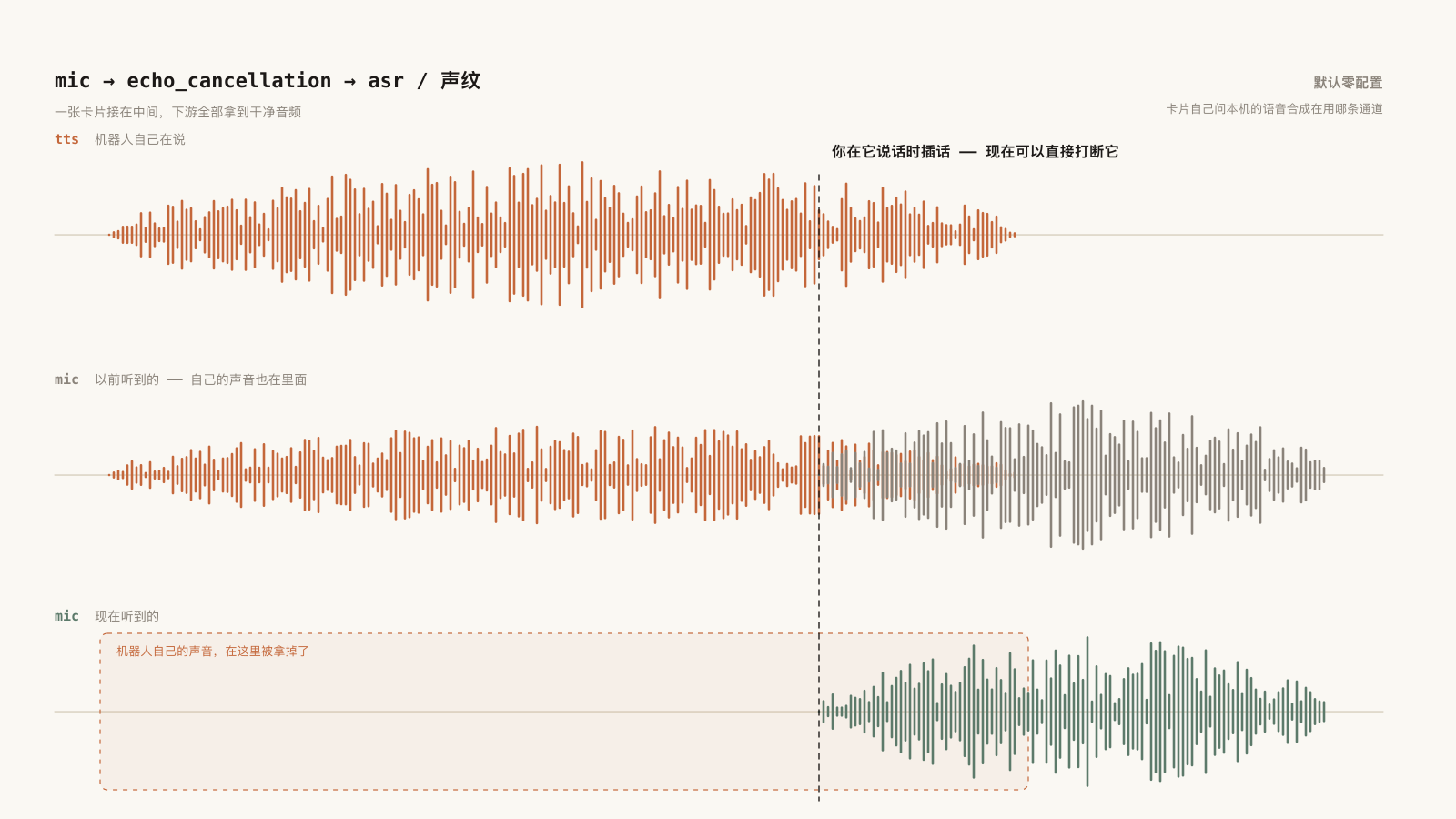
One card, everything downstream benefits
The robot’s own speech bleeds acoustically into its microphone, and the symptoms show up in three different places that none of them look like an echo problem: speech recognition hands the robot’s own sentence to the model as if a person had said it; the voiceprint files that sound away as a person; and nobody can interrupt the robot while it is talking.
That is why this is a card between the microphone and the rest, not a switch inside speech recognition. Everything downstream gets clean audio at once, and the cleaned-up audio is a stream a human can actually listen to on the dashboard.
No half-duplex
Muting the microphone while the robot speaks would be the easy fix, and it would defeat the entire point: you could no longer interrupt it. So there is no mode switch. Muting survives only as a brief warm-up — about three seconds, once per session, before the delay has been measured.
Two costs, stated up front
One extra hop (a single chunk, 32–100 ms) and one extra segment in the downstream topic name. Inserting this card into a robot that is already running is therefore not a no-op change.