The simulation environment is now part of the platform — build agents and skills without a robot
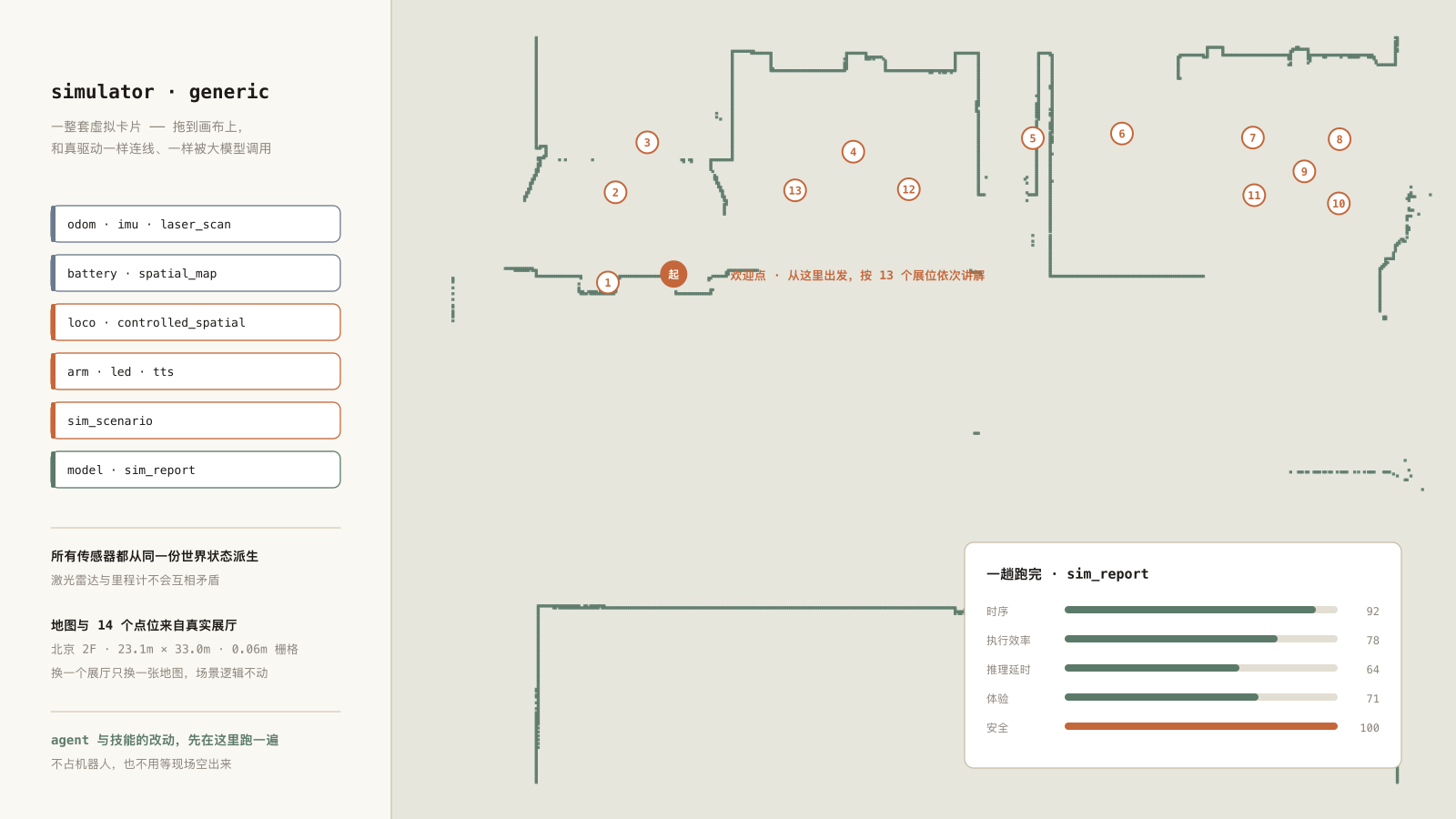
A full set of virtual cards — odometry, IMU, lidar, battery, map, locomotion, navigation, arm, LED, speech, scenario — now drops onto the canvas and behaves exactly like real driver cards. Agent logic, skills and prompts can be built and run end to end without queueing for a real robot. The default world is the real Beijing 2F showroom, map and all 14 waypoints exported from the floor itself.
Why this matters
Everything the platform does is wired together on one canvas and driven by a model. Until now, trying any of it meant having a robot: a free one, a charged one, in a room with the right layout, with nobody else testing on it. That is the real cost of iterating on an agent — not the code.
These cards are indistinguishable from driver cards to everything above them. They register the same way, speak the same formats and get called by the model the same way, so not a line of the agent needed changing to run against them. You wire up a canvas, run a task end to end, and read the result.
A world that does not contradict itself
Every sensor is derived from one shared world state rather than each making up its own numbers — so the lidar and the odometry can never disagree. The IMU reports only what this world actually has, and says so, rather than padding the gaps with constants that look like measurements. A virtual wall is a real change to the occupancy grid, so the lidar sees it; obstacles have an honest source instead of a second made-up card.
Protected operations still demand their password. A simulation that skips the check teaches people the real robot skips it too.
The default world is a real building
The default scenario is the Beijing 2F showroom: the map was exported from the robot on that floor (23.1 m × 33.0 m at a 6 cm grid), the 14 waypoints come from the same export, and the running order comes from the published guided-tour skill. Watching an agent navigate to “exhibit area 1” now means it really is that area. Changing buildings means dropping in one map file — the scenario logic does not move. Maps can be dropped into a directory like scenarios, with no image rebuild.
At the end of a run the report scores it: timing, execution efficiency, reasoning latency, experience, safety.